
What Is a Useful Batch Size?
A pragmatic guide to selecting sample volumes that provide statistically sound repeatability insights without wasting machine hours or expensive engineering polymers.
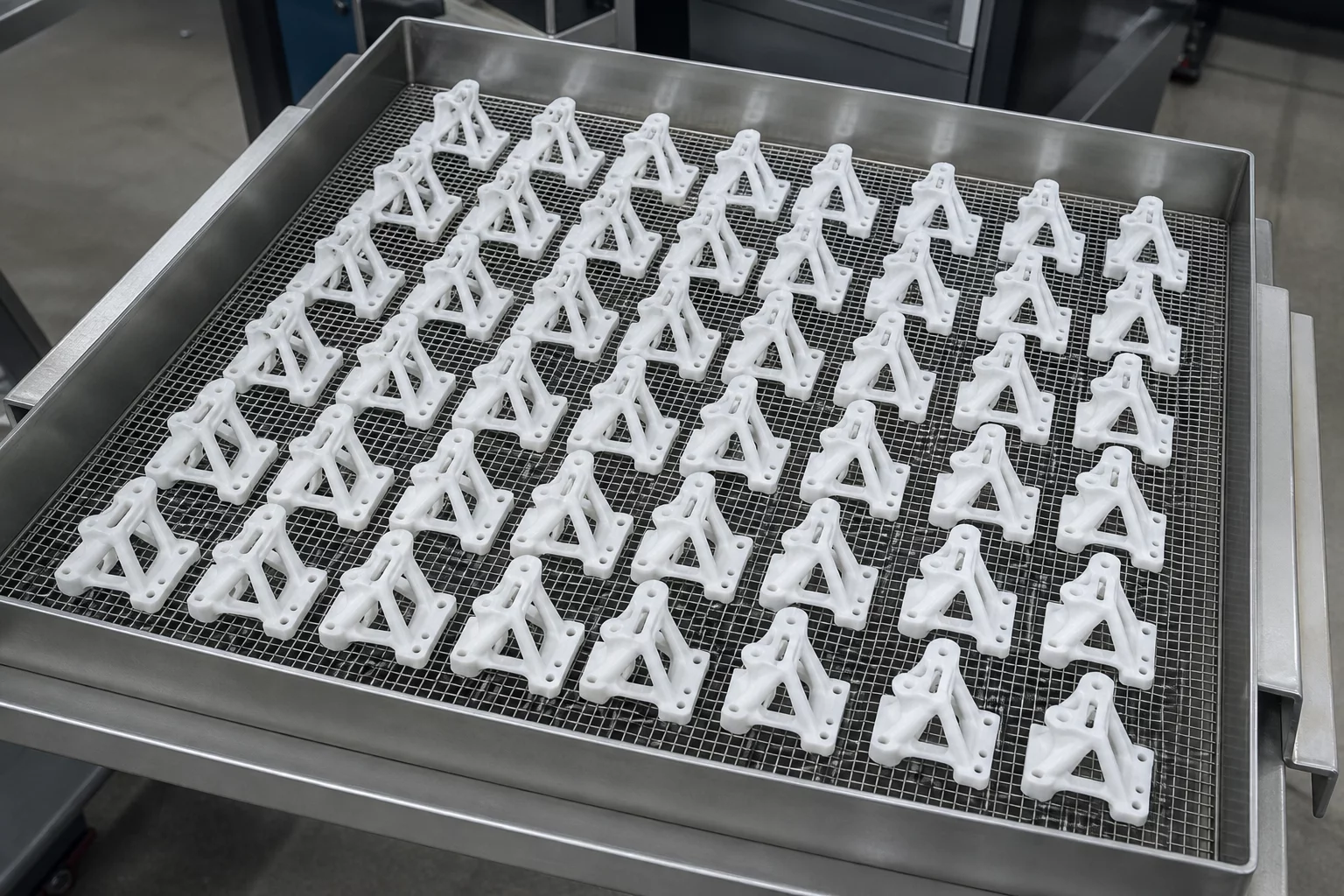
Evaluation Scope and Metrological Standards
Determining a useful batch size in additive manufacturing and low-volume serial production requires balancing statistical rigor against material consumption. Printing two or three prototypes demonstrates basic geometry, yet it fails to uncover bed-level thermal gradients, nozzle erosion rates, or layer time variances. Conversely, fabricating hundreds of units before verifying baseline process capability creates avoidable scrap if dimensional drift goes undetected.
For most engineering workshops utilizing industrial FDM or SLS systems, an initial validation batch of 12 to 24 parts across at least two independent print jobs yields sufficient data. This sample quantity allows quality engineers to compute meaningful standard deviation metrics and establish baseline Cpk envelopes while keeping turnaround cycles agile.
Fieldbook Inspection Benchmark
Statistical process control relies on repeatability across all batch specimen samples rather than a single ideal part. Ensure consistent thermal bed calibration and optical micrometer zero-points before taking measurement passes.
Process Variation Breakdown
When selecting your sample quota, categorize variation into intra-build and inter-build sources. Intra-build variance reflects location-specific differences on the build plate, such as auxiliary cooling drafts or edge warping. Inter-build variance reflects spool batch shifts, ambient temperature changes, and mechanical calibration decay over consecutive cycles.
- Minimum qualification lot: N=8 units per build plate to capture edge-to-center thermal gradient shifts.
- Recommended pilot lot: N=25 units across 3 consecutive builds to establish reliable Cpk distribution.
- Statistical threshold: Standard error falls below ±0.012mm once sample size exceeds N=15 specimens.
Interactive Tolerance & Batch Matrix
Live parameter verification module
Inspection Peer Reviews & QC Logs
Field measurements submitted by metrology specialists
Submit Field Inspection Comment
Record dimensional observations or variance queries for this item.